Guide
A backyard or private property wedding
By Annie Cormack, founder of Rosel · Updated
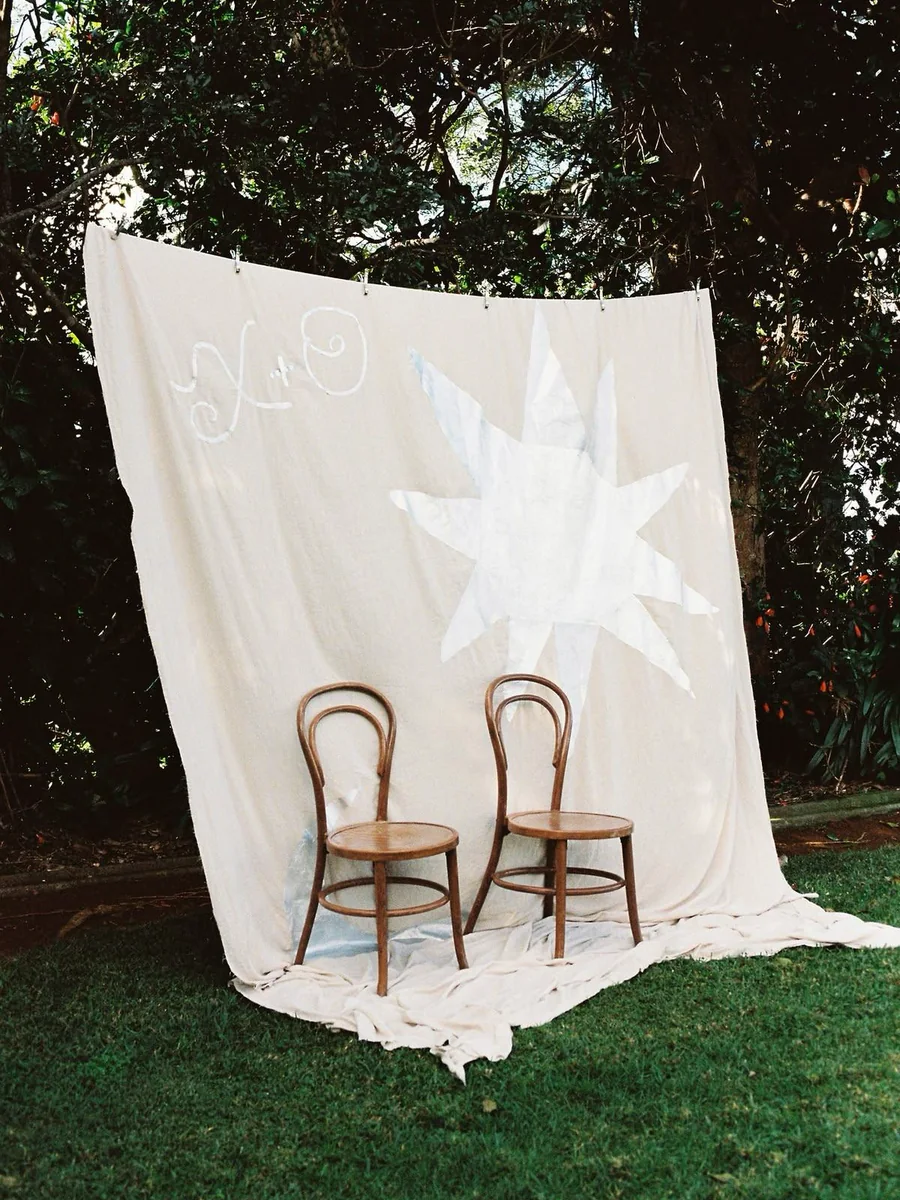
This page covers holding a ceremony or a celebration at a home, a farm, or a family member’s or friend’s place: the approvals, the infrastructure a house doesn’t have for a crowd, the rules on noise and liquor in each state, cooking for a crowd safely, and the jobs to hand out. It’s for couples who are using a property they already have, or have been offered, and building the day on it from scratch.
What a property gives you, and what it doesn’t
A property gives you the place. Almost everything a venue supplies comes in separately: cover, power, toilets, a kitchen for whoever’s cooking, cold storage, furniture, lighting, bins, and the people to run them. Start with a walk around the site and two lists: what’s already there (a shed, a verandah, a kitchen, a bathroom, power points, a tap), and what has to come in.
If the property isn’t yours, get the owner’s agreement in writing, including the dates for bump-in and pack-down and what happens if something is damaged. If it’s a townhouse or unit, check the strata or owners corporation by-laws on gatherings, noise and common property. Short-stay rentals usually ban parties outright; that’s covered on the short-stay way, not here.
Do you need council permission?
For a private, invitation-only wedding at a home, generally no. No council issues a “wedding permit” for private land in the way it does for a park or a beach. What can need approval is a structure: a marquee, a stage or a raised platform above a certain size. A skip bin or anything else placed on the road or nature strip also needs a council permit (see Rubbish, below).
Things that change the answer: charging guests anything (a ticket, a cash bar), a heritage-listed property, bushfire-prone land, or a site big enough to look like a public event. In any of those cases, ask the council before you book the hire.
Marquees and temporary structures, by state
Most hire companies know the local rules and supply engineering or compliance paperwork for their structures. Ask them, in writing, whether your size and layout needs approval where you are.
| State | What we found | How confident |
|---|---|---|
| NSW | A tent or marquee for a private function such as a wedding is exempt development (no approval) if it meets the Codes SEPP standards. On residential land: total floor area of all tents no more than 200 m² in a residential zone (300 m² in other zones), no higher than 6 m, up no more than 7 days for a private function, at least 1 m from every boundary and behind the building line. It must be put up to the manufacturer’s specifications, on firm, level ground, with the owner’s written consent, and must not block parking or vehicle and pedestrian access. On bushfire-prone land, extra standards apply. Outside those limits, it needs approval. | Read in full from the NSW Planning Portal in an earlier session; numbers re-confirmed by search summary |
| VIC | A marquee over 100 m² is a “prescribed temporary structure” and needs an occupancy permit from the building regulator, plus siting approval from the council, before it’s used for public entertainment. “Public entertainment” means an event members of the public can pay to get into, so a private, invitation-only wedding at home may sit outside it. Ask the hire company whether the marquee holds a current occupancy permit and whether your council wants a siting approval regardless. | Rule from the VBA; how it applies to a private wedding is from search summaries, not confirmed |
| QLD | Erecting a tent of up to 100 m² is exempt building work; a tent of up to 500 m² is self-assessable (no certifier, but it still has to meet the building rules, including being structurally sound). Larger needs building approval from a private certifier. | From the Building Regulation 2021 via search summary; not confirmed |
| WA | Tents and marquees for private functions on a private residence are exempt from a building permit if they’re up for less than one month. Planning or health approvals may still apply. | From a WA council information sheet via search summary |
| TAS | A marquee is a “temporary structure”, and using one for an event, public or private, needs a temporary occupancy permit, unless it’s a single tent or gazebo under 75 m² with no ignitable fuel source within 10 m. | From the Tasmanian building regulator via search summary; not confirmed |
| SA | Not checked. Ask the council or PlanSA. | |
| ACT | Not checked. Ask Access Canberra. | |
| NT | Not checked. Ask the building advisory service. |
Two things to sort with any marquee, wherever you are:
- What’s underground. Marquee pegs can go through water pipes, gas lines, irrigation and cables. Before You Dig Australia (byda.com.au) is a free national service that sends plans of buried services, though it doesn’t cover private pipes on the property itself. The owner usually knows where those run.
- Wind and weather. Hire companies set a wind limit for their structures and will ask you to clear the site if it’s exceeded. Ask what the limit is, and what happens on the day if the forecast goes over it.
Wet-weather cover
Whatever the weather does, it happens on the property. Decide on cover early: a marquee with walls and a floor, a roof and shade only, an existing shed or verandah, or a combination. Marquee and flooring hire books out months ahead in peak season, so this is one of the first bookings, not one of the last.
Think through:
- Where everyone goes if it rains during the ceremony, and whether it fits them seated.
- Flooring, so heels and chairs don’t sink into wet grass.
- Walls for wind and cold, and shade and airflow for heat. Heaters and fans need power.
- A covered path between the marquee, the toilets and the house.
Ground and access
Everything arrives by truck: the marquee, toilets, furniture, the cool room, the bar, a food truck if you have one. Before you book, check:
- The way in. Gate width, overhead clearance (trees, wires, carports), and whether the driveway or paddock holds a loaded truck. Toilet trailers commonly need a clear route about 2.5 m wide; ask each hire company for its own measurements.
- The ground. Slope and drainage. A marquee and a toilet trailer need firm, level ground. A lawn that’s soft after rain can bog a truck and leave ruts.
- Prep. Mow, level, clear, and move whatever has to move (cars, outdoor furniture, the trampoline) before the hire arrives.
Send every supplier the same short access note: the address, where to park, the gate, the ground, and a phone number for the day.
Power and generators
A house’s power points aren’t built for a PA, lighting, a bar fridge, a cool room, urns and heaters all on at once. List everything that needs power, then ask an electrician whether the house circuits can carry it, and where.
If they can’t, hire a generator sized to the list. The safety rules from Energy Safe Victoria and other regulators:
- Run a generator outdoors only, never in a shed, garage or enclosed space, and away from doors, windows and the marquee. Its exhaust carries carbon monoxide, which can’t be seen or smelt.
- Never plug a generator into a power point or connect it to the switchboard. Any change to house wiring is a licensed electrician’s job.
- Use a generator with RCD (safety switch) protection, and outdoor-rated leads, kept out of puddles and off walkways.
- Ask the bar, caterer, band and toilet company what each needs, and whether they bring their own.
Toilets
Guests using the house bathroom for a few hours puts a heavy load on a single toilet, and a septic system may not cope. Hire companies give their own ratios, generally around one toilet per 40 to 50 guests for an event of about four hours, with more when a bar is running. These are industry guidance, not a rule; tell the hire company your numbers, the length of the event and whether there’s a bar, and let them size it.
Ask the hire company:
- How the units arrive, how much room they need, and whether the truck can reach where you want them.
- Whether they need power (lights, flushing, fans) and a water connection, or run from onboard tanks.
- When they’re delivered and collected, and whether they’re serviced mid-event.
- Whether they supply handwash stations and lighting.
Put them somewhere level, lit and reachable without crossing the dance floor.
Water
Plan for drinking water for guests, especially on a hot day; handwashing near the toilets and the food; a tap or hose for the bar, the kitchen and some toilet units; and ice. On a property on tank water, check how much is in the tank and whether guest use will run it down.
Noise: when amplified music has to stop, by state
Each state sets its own rules for music at a home. In most, a neighbour’s complaint to police or council is what triggers action, and noise can be found unreasonable even inside the permitted hours. Tell the neighbours ahead (see below) and plan the music to finish on time.
| State | What we found |
|---|---|
| NSW | Amplified music and instruments shouldn’t be heard in a neighbour’s habitable room after midnight on a Friday, Saturday or the night before a public holiday, or after 10pm on other nights (until 8am). Police and council can issue a noise abatement direction and seize equipment. |
| VIC | Amplified music is prohibited after 11pm on a Friday or Saturday (and public holidays), and after 10pm Sunday to Thursday. |
| QLD | There’s no set curfew for party music at a home. Police can act if they judge the noise “excessive” in the circumstances, and can direct you to stop it; the direction lasts 96 hours. Council rules restrict amplifying devices such as PA systems after 10pm. |
| WA | Music from a party will generally exceed the permitted noise levels under the Noise Regulations. Councils say neighbours generally accept a one-off party if told the date and the time the music goes off. Complaints go to police or council. |
| SA | No set hours for music at a home. It’s at the discretion of police, who handle party noise complaints. |
| TAS | Amplified music and instruments are prohibited after 10pm Sunday to Thursday, and before 7am on a Friday, 9am on a Saturday and 10am on a Sunday or public holiday. No set finish on Friday or Saturday night, but the noise can still be ruled an environmental nuisance. |
| ACT | Noise in residential areas is limited by decibel level, dropping at 10pm. Most amplified music outdoors will exceed the night limit. |
| NT | The NT EPA’s guidance is for music to be off or turned down by midnight on a Friday, Saturday or the night before a public holiday, and 10pm on other nights; it notes the midnight finish is common practice rather than law. Police deal with complaints under an “undue noise” test. |
A rural property with no near neighbours still sits under these rules; there’s just less chance of a complaint. A band or DJ will know the local practice, and many carry a sound limiter. Give someone the job of turning the music down at the agreed time.
Neighbours
Tell the neighbours a week or two ahead: drop a note in their letterboxes with the date, when guests arrive, when the music stops, when deliveries and pack-down happen, and a mobile number for someone (not either of you) who’ll answer on the day. Some couples invite the nearest neighbours.
Parking
Work out where cars go before you send the invitations. Check the street: guests can’t block driveways, footpaths or fire hydrants, and some streets have parking restrictions on weekends. On a farm, mark a paddock or a strip of firm ground, and check it holds cars if it’s rained. Keep the driveway clear for suppliers and an ambulance. If guests are driving home, plan transport, a shuttle or taxis at the end, and somewhere for those who stay.
Where the bar goes
The bar draws people. Keep it away from the entrance, so guests don’t bank up as they arrive, and set it deep in the space: it pulls people through and spreads them out.
Lighting
A backyard that’s lit by a porch light at sunset is dark by the speeches. Light the paths, the steps, the toilets, the car park, the bar and the food, as well as the dance floor. Use outdoor-rated festoons and leads. On a Total Fire Ban day, open flame outdoors and under a marquee is stopped, including candles, torches, fire pits and in many places a spit or wood barbecue; check your state’s fire authority for what’s allowed, and have battery candles as a fallback.
Rubbish
A wedding fills more bins than the council collection takes. Plan general waste, recycling and food waste; bins near the bar and the food; and who empties them during the night. Beer, cider and premix cans and bottles can go to a container refund scheme. A skip bin on your own driveway or land doesn’t need a permit; on the road, footpath or nature strip, it needs council approval in NSW, Victoria and Queensland, and likely elsewhere.
The day after
Hire a cleaner for the next day. Platforms such as Airtasker let you book someone for a few hours to clear up, so the morning after isn’t spent on it.
Drinks and liquor licences
Giving drinks away at a private wedding and selling them are different things, and what each needs differs by state. The rules differ by state and Rosel doesn’t state them: each regulator’s page is the place to check. New South Wales · Victoria · Queensland · Western Australia · South Australia · Tasmania · Northern Territory · The ACT
Guests under 18
Every state limits who can give alcohol to someone under 18 on private property. In most, it needs the parent’s or guardian’s consent and responsible supervision; in Queensland, only the parent or guardian can supply it. Brief whoever is running the bar on which guests are under 18.
Using a licensed mobile bar
A mobile bar can either pour drinks you’ve bought or supply the drinks itself. Whether its licence covers your event is for the bar and your state’s regulator to say; ask for the licence number.
Ask what they need from the site: level ground, a way in, room to work, power and water. Ask whether ice and glassware come with them.
Cooking for a crowd safely
Food that’s given away, not sold, isn’t a food business, so family and friends cooking for a wedding need no registration. The food safety rules still apply to the food itself, and they matter more at scale.
Hot, cold, and the danger zone
Keep cold food at 5°C or colder, and hot food at 60°C or hotter. Between those, bacteria grow. A food thermometer settles any doubt.
The high-risk foods are meat, poultry, seafood, dairy, eggs, cooked rice and pasta, quiches, and prepared salads.
The 2-hour/4-hour rule
Once high-risk food is out of the fridge or off the heat:
- Under 2 hours out: use it, or put it back in the fridge.
- 2 to 4 hours: use it, don’t put it back.
- Over 4 hours: throw it out.
The time adds up across the day, including the drive there and time on a platter.
Cooling cooked food
Cooked food made ahead has to cool in two steps: from 60°C to 21°C within 2 hours, then from 21°C to 5°C within the next 4 hours. Shallow containers and smaller portions do this; a large pot in the fridge can stay warm in the middle for a day. Fridge space decides how much you can cook ahead, more than oven space.
Hot holding and reheating
Food served hot has to stay at 60°C or above. Use chafing dishes, warming ovens or slow cookers, and plan where they plug in. Reheat cooked-ahead food until it’s steaming hot all the way through, then hold it hot.
Transport
Move cold food in eskies with ice bricks or in a car fridge, and hot food in insulated carriers. If a drive is long, it’s often easier to cook, cool and transport food cold, then reheat it on site.
Allergens
Ask guests about allergies with the RSVP. Label every dish with what’s in it, especially the common allergens (peanuts, tree nuts, milk, egg, sesame, fish, shellfish, soy, wheat and gluten, lupin). Serve allergy meals first, keep them apart and give them their own serving spoons. On a bring-a-plate table, ask each guest to bring a label with their dish.
The jobs to hand to people
On a property, the day only runs if each of these has a name against it.
- Site lead: the person suppliers call, who knows where everything goes
- Neighbours: drops the note in their letterboxes, and answers the phone on the day
- Clean-up: books a cleaner for the next day
- Deliveries and bump-in: meets each truck, shows them where to set up
- Parking: directs cars, keeps the driveway clear
- Power: knows where the generator and leads are, and what’s on which circuit
- Toilets: keeps them stocked with paper, soap and light
- Cooking: who cooks each dish, and on what schedule
- Food timing: watches how long food has been out, and brings it in
- Serving: who plates and who carries
- Allergy meals: makes sure they reach the right people
- Bar: runs the bar all night, sober
- Ice and drinks: keeps the cold stock moving from storage to the bar
- Music: runs the playlist or liaises with the band or DJ, and turns it down at the curfew
- Weather: watches the forecast in the days before, and calls the wet-weather plan
- Lighting: switches it on before dusk
- Bins: empties them during the night
- First aid: has a kit and knows where the nearest hospital is
- Pack-down: who stays to clear up, and who’s back the next day for collections
- Returns: unopened drinks, hired gear, and container refunds
Sources
- NSW temporary structures: https://www.planningportal.nsw.gov.au/development-and-assessment/planning-approval-pathways/exempt-development/temporary-uses-and-structures
- NSW Codes SEPP: https://legislation.nsw.gov.au/view/whole/html/inforce/current/epi-2008-0572
- VIC prescribed temporary structures: https://www.vba.vic.gov.au/building/prescribed-temporary-structures
- VIC places of public entertainment: https://www.vba.vic.gov.au/__data/assets/pdf_file/0014/152330/Building_BP_10-Places-of-public-entertainment.pdf · https://www.melbourne.vic.gov.au/public-entertainment-and-temporary-structure-siting-approvals
- QLD Building Regulation 2021: https://www.legislation.qld.gov.au/view/whole/html/inforce/current/sl-2021-0126 · https://classic.austlii.edu.au/au/legis/qld/num_reg/br2021182/sch1.html
- WA temporary buildings: https://www.kwinana.wa.gov.au/council/documents,-publications-and-forms/publications-and-forms-(all)/information-sheets-and-guides/2022/temporary-buildings
- TAS temporary occupancy permits: https://cbos.tas.gov.au/topics/technical-regulation/building-standards/permit-authorities/temporary-occupancy-permits
- Before You Dig Australia: https://www.byda.com.au
- Generator safety: https://www.energysafe.vic.gov.au/community-safety/emergencies/using-generator-safely
- Toilets (industry guidance): https://instanttoilets.com.au/how-many-toilets-do-i-need/ · https://instanttoilets.com.au/portable-wedding-toilets/
- NSW noise: https://www.epa.nsw.gov.au/Your-environment/Noise/neighbourhood-noise/preventing-neighbourhood-noise · https://www.georgesriver.nsw.gov.au/Environment/Pollution/Noise-Pollution
- VIC noise: https://www.epa.vic.gov.au/residential-noise
- QLD noise: https://www.police.qld.gov.au/initiatives/party-safe/noisy-parties-what-you-need-to-know · https://www.austlii.edu.au/cgi-bin/viewdoc/au/legis/qld/consol_act/ppara2000365/s578.html · https://www.brisbane.qld.gov.au/laws-and-permits/complaints/noise-restrictions-and-complaints
- WA noise: https://www.kwinana.wa.gov.au/council/documents,-publications-and-forms/publications-and-forms-(all)/information-sheets-and-guides/2020/control-of-stereo-noise-and-parties-guidelines
- SA noise: https://www.epa.sa.gov.au/community/neighbourhood-nuisance
- TAS noise: https://epa.tas.gov.au/environment/noise/noise-management/residential-noise-and-hours-of-use
- ACT noise: https://www.accesscanberra.act.gov.au/noise-management/noise-standards
- NT noise: https://ntepa.nt.gov.au/__data/assets/pdf_file/0004/1061869/neighbourhood-noise-factsheet.PDF
- Skip bins: https://www.gleneira.vic.gov.au/services/support-and-safety/local-law-requirements/skip-bins-on-council-land · https://www.bingoindustries.com.au/our-services/skip-bin-hire/council-permits-for-skip-bins
- NSW liquor: https://www.nsw.gov.au/business-and-economy/liquor-and-gaming/liquor-licensing/apply-manage/not-required · https://www.nsw.gov.au/business-and-economy/liquor-and-gaming/liquor-licensing/licence-types/single-function
- VIC liquor: https://www.vic.gov.au/check-you-need-liquor-licence · https://www.vic.gov.au/apply-temporary-limited-liquor-licence
- QLD liquor: https://www.business.qld.gov.au/industries/hospitality-tourism-sport/liquor-gaming/liquor/licensing/licences-permits/community-liquor-permits · https://www.business.qld.gov.au/industries/hospitality-tourism-sport/liquor-gaming/liquor/licensing/licences-permits/types · https://www.police.qld.gov.au/initiatives/event-safe
- WA liquor: https://www.dlgsc.wa.gov.au/racing-gaming-and-liquor/liquor/liquor-applications/online-lodgement-guide/online-lodgement-guides/occasional-liquor-licence-lodgement-guide
- SA liquor: https://www.sa.gov.au/topics/business-and-trade/liquor/apply/short-term
- TAS liquor: https://www.treasury.tas.gov.au/liquor-and-gaming/liquor/permits/special-permits
- ACT liquor: https://www.accesscanberra.act.gov.au/business-and-work/hospitality-liquor-and-gaming/liquor-permits
- NT liquor: https://nt.gov.au/industry/liquor/sell-supply-serve/licence-or-registration · https://nt.gov.au/law/alcohol-rules-and-restrictions
- Mobile bars: https://www.wedlockers.com.au/planning/mobile-bar-nsw/ · https://kubarz.com.au/services/event-liquor-licensing/
- Secondary supply: https://adf.org.au/insights/understanding-secondary-supply/
- Food business registration (QLD): https://www.qld.gov.au/health/staying-healthy/food-pantry/starting-a-food-business/food-business-licences/do-i-need-a-food-business-licence
- Food safety: https://www.foodstandards.gov.au/business/food-safety/2-hour-4-hour-rule · https://www.foodstandards.gov.au/business/food-safety/cooling-and-reheating-food · https://www.foodstandards.gov.au/business/charities/temperature-control · https://www.foodstandards.gov.au/business/charities/transporting · https://www.foodsafety.asn.au/food-safety-on-the-move/
- High-risk foods: https://www.geelongcity.vic.gov.au/services/business-and-investment/food-registration/food-safety-community-groups-events
- Allergens: https://www.foodauthority.nsw.gov.au/industry/food-allergen-rules
- Container refunds: https://en.wikipedia.org/wiki/Container_deposit_schemes_in_Australia
- Total Fire Ban: https://www.dfes.wa.gov.au/hazard-information/bushfire/total-fire-ban · https://venyu.com.au/fire-bans-what-you-need-to-know-about-them-for-your-wedding/